AI Chatbot vs Live Chat: Which One Does Your Business Actually Need?
If you are responsible for customer experience, you have almost certainly stared at a procurement sheet and wondered whether to buy live chat seats, deploy an AI chatbot, or somehow stitch the two together. The market does not make that decision easier: every vendor claims speed, empathy, and ROI in the same breath. What actually matters is the job each tool does when a real person is on your site with a real question.
Live chat and AI chatbots are not two brands of the same product. Live chat is a human channel: asynchronous or real-time messaging that only works when someone on your team is present, trained, and not underwater in queue. A chatbot is a software layer that tries to answer from the knowledge you have written down—policies, pages, FAQs, PDFs—before a human ever sees the conversation.
This article walks through that distinction without pretending one side always wins. You will see where automation is genuinely stronger, where humans still have no substitute, what a hybrid workflow looks like in practice, and how to think about cost without comparing apples to oranges. By the end, you should know what to implement first on your own site and what to measure once it is live.
First, What We Are Actually Comparing
Live chat, at its best, feels like a short hallway conversation: a visitor asks something specific, an agent reads context, and the reply can adapt mid-thread. That flexibility is powerful when the issue is messy—billing edge cases, a misunderstood feature, a customer who is upset and needs to feel heard. The trade-off is capacity. Every concurrent chat consumes a person. When volume spikes or the clock hits closing time, the experience changes: longer waits, handoffs, or silence.
A modern AI chatbot is different in kind. It does not “feel” the room the way a great agent does. What it can do—when trained properly—is retrieve and summarise what your business has already published, consistently and at high volume. It does not replace judgment in ambiguous situations; it reduces how often humans have to spend their judgment on questions that were never ambiguous in your documentation.
The mental model that helps most teams is traffic routing, not replacement. You are deciding what should hit a human first versus what can be resolved from structured knowledge. Once you stop asking “chatbot or live chat?” and start asking “what belongs in each lane?”, the stack design gets much simpler.
Side-by-Side Comparison
The table below is intentionally high level. Payroll and benefits for agents vary wildly by country and role; chatbot vendors price on messages, training pages, and features. Use it to orient, then plug in your own numbers when you build a business case.
| AI Chatbot | Live Chat | |
|---|---|---|
| Availability | 24/7 when deployed | Typically business hours unless you staff overnight |
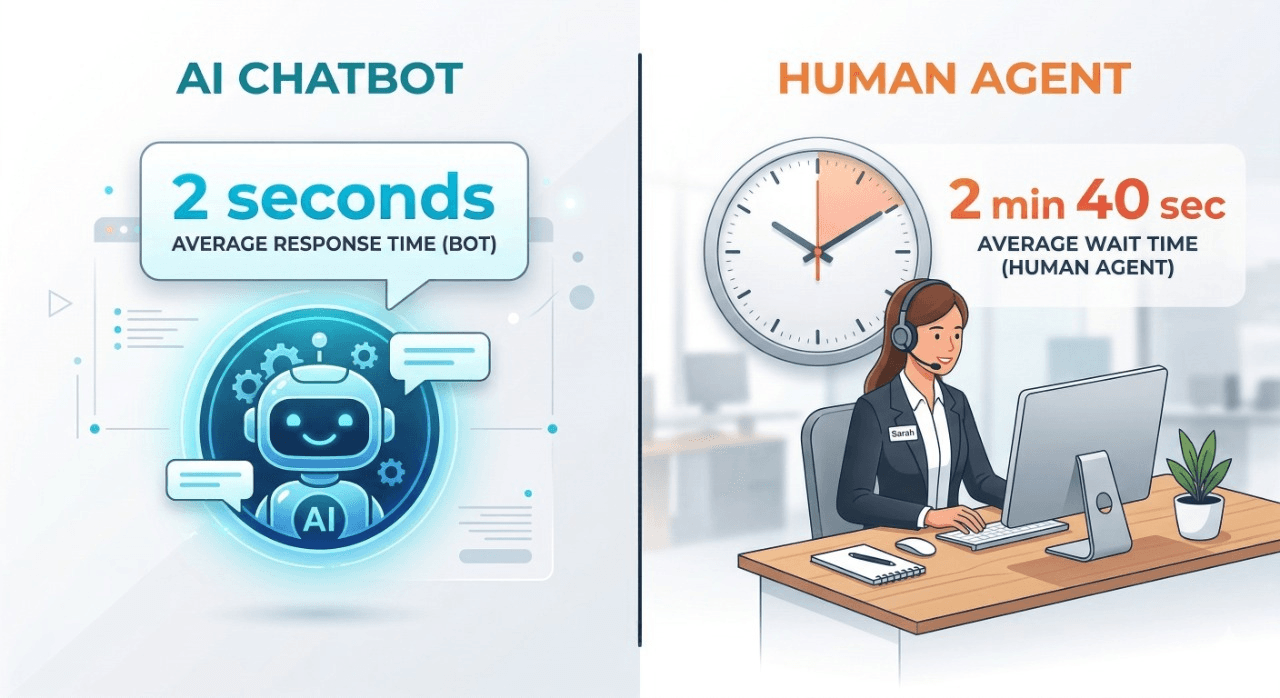
| Response time | Often within seconds when the answer is in training | Industry benchmarks often cite several minutes for first human reply |
| Concurrent volume | Scales with usage limits on your plan | Limited by agents online (often a few chats per agent) |
| Cost model | Mostly software subscription + usage | Salary, benefits, tools, and management |
| Best for | Routine, high-volume, informational questions | Complex, emotional, or high-judgment issues |
| Empathy & nuance | Limited vs a skilled human | Full human range when agents are well trained |
| Consistency | Grounded in the same training data (exact wording can vary) | Varies by agent, shift, and queue pressure |
Reading the rows vertically tells a story: automation is strongest where the work is documented, repeatable, and time-sensitive. Humans are strongest where the work is relational, ambiguous, or emotionally loaded. Neither column “wins” in the abstract—they score points in different innings.
The trap is comparing them as logos instead of workloads. If eighty percent of your inbound questions are some variant of “how does pricing work?” or “where is my order?”, a trained bot will surface that information faster and more consistently than a busy queue. If eighty percent of your inbound is “my account is wrong and I am upset”, you need people, process, and possibly screen-share—not a paragraph from a FAQ.
Where AI Chatbots Win
Speed is the first advantage people feel in the product. Live chat has a queue because humans cannot parallelise attention the way software can. Industry reporting consistently shows multi-minute first-response times for human chat, and real teams still miss conversations when volume spikes. A chatbot that answers from your knowledge base can return a first response as soon as the model and hosting allow—usually quickly enough that the visitor experiences continuity instead of waiting. That matters most for the long tail of straightforward questions: shipping cutoffs, return windows, plan limits, and anything else you have already written down clearly.
Availability follows directly. Your agents go home; your website does not. If you sell to multiple time zones, or if your prospects research late at night, “we will reply in the morning” is sometimes acceptable—but often it is not, because the visitor is already comparing you to a competitor who answered immediately. A deployed bot is not a substitute for empathy at two in the morning, but it is a substitute for silence.
Cost behaves differently at scale. Hiring is lumpy: every new chunk of coverage is another salary line, benefits, onboarding, and management overhead. Chatbot pricing is usually a subscription with limits on messages and training pages—predictable in accounting terms, and it does not double the moment traffic doubles. Heavy usage can still push you to a higher tier, which is why you should model message volume honestly instead of assuming “unlimited” means free at any scale.
Finally, repetitive volume is where automation earns trust with operators. A huge share of real-world support load is not novel; it is the same questions with different phrasing. When those answers live in your help content, a bot can shoulder the repetition so your humans spend their hours on exceptions, VIP accounts, and situations that genuinely need discretion.
Where Live Chat Wins
Complexity is the obvious human edge. The moment a ticket requires pulling data from multiple systems, making an exception to policy, or sequencing several actions in the right order, you are past what a generic retrieval bot can safely do without deep integrations. A skilled agent can navigate ambiguity, ask clarifying questions, and escalate internally. That is not “better technology”—it is a different job.
Emotion is the second edge. When someone is frustrated, embarrassed, or angry, the goal of the conversation is often not raw information. It is feeling heard. Tone, pacing, and a sincere apology matter. A chatbot can acknowledge emotion in text, but it cannot replace a human who has been trained to de-escalate and to know when to stop selling and start repairing trust.
High-value sales is the third edge. On large or nuanced purchases, buyers often need dialogue: follow-up questions, reassurance about fit, and someone who can read hesitation. Industry research has repeatedly linked live engagement on commerce sites to higher conversion than no chat, especially when the product is expensive or unfamiliar. A bot can summarise your pricing page; it should not pretend to be a senior account executive.
Expectations matter too. Many people are fine with a bot for simple questions and still want a visible path to a person when stakes rise. Live chat—or another clear human channel—is how you honour that expectation without training visitors to fight your automation.
The Practical Answer: Use Both, Deliberately
Once you separate workloads, the architecture gets simpler. Let automation own the well-documented, high-frequency layer: FAQs, policy summaries, product facts, and anything else you would happily hand a new hire a playbook for. Let humans own judgement calls, emotional recoveries, and sales conversations where nuance closes revenue. The handoff should feel like escalation to help, not punishment for using the bot.
In practice that means your bot should answer first when it can, admit limits honestly when it cannot, and point to a single obvious next step—a live queue during business hours, an email with a real SLA, or a form that routes to the right team. That is the same philosophy we explore in our article on why customers hate chatbots: bad bots trap people; good bots shorten the path to the right answer or the right person.
Who Should Prioritise What
If your support inbox is dominated by repetitive, informational questions—hours, shipping regions, plan comparisons, basic troubleshooting—you will usually get more leverage from a well-trained bot than from another half seat of live chat coverage. The same is true if you are small: one or two people cannot sit in a queue all day without burning out, but a bot can cover the baseline while humans batch-handle exceptions.
Live chat as the primary channel makes sense when conversations routinely require account access, bespoke quotes, or persuasive selling. If your average ticket is “log in and look at my billing with me”, automation will not replace that without serious backend integration—and maybe not even then. Low volume can also favour humans-first: if you only see a handful of chats a day, a great agent experience can be your differentiator.
Most mid-sized teams end up with both in some form: automation for coverage and speed, humans for depth. You might staff live chat during business hours only, while the bot carries nights and weekends. You might route enterprise prospects straight to sales while the bot handles self-serve plans. The exact split matters less than being intentional about who sees which workload.
What This Costs in Practice
Fully loaded live chat is rarely “just the software fee.” You are buying seats, supervision, quality assurance, and often weekend or overnight coverage if you promise real-time humans around the clock. Even a modest blended rate for part-time help adds up fast when you multiply by hours. Chatbot software is usually a smaller line item—but you still pay for it with careful training, testing, and ongoing updates, or you pay with customer trust instead.
On customsupportai.com specifically, you can start on the Free plan: one chatbot, 200 messages per month, and 50 training pages (20 website + 30 document), with no credit card required to begin. Pro is $39 per month and raises limits—including 5,000 messages per month and 1,000 training pages among other caps. Pro Plus is $99 per month with 10,000 messages per month, two chatbots, and 4,000 training pages. Numbers and features can change, so treat customsupportai.com/pricing as the source of truth. The economic point for this article is simpler: software tiers are usually easier to forecast than headcount, which is why teams pair a bot with fewer agent hours instead of pretending one replaces the other.
Mistakes Teams Make When They Choose a Channel
The most expensive mistake is scaling live chat without any automation layer. Volume grows with your business; headcount grows with volume. Eventually you either hire into unsustainable cost or let wait times slip. A parallel mistake is deploying a chatbot with no human path at all—visitors with real edge cases feel abandoned, and one bad experience can undo dozens of smooth self-serve interactions.
Another common error is treating the decision as tribal: “we are a live-chat company” versus “we are an AI company.” In reality your customers do not care about your stack; they care whether they got an accurate answer quickly or whether someone competent helped them when things got hard. The channel mix should follow the ticket mix.
What to Carry Forward
If you remember nothing else, remember that speed and coverage favour well-trained automation for documented work, while empathy and judgement favour humans for messy work. Hybrid routing is not a compromise—it is how serious support organisations actually operate. Measure answer quality and customer outcomes alongside operational metrics like deflection, or you will optimise for the wrong thing.
Align your roadmap to the questions you really receive, not to a generic feature checklist from a vendor slide. The right split for a B2B SaaS company with long sales cycles will not match a local service business with phone-heavy support—and that is exactly how it should be.
Start With the AI Layer, Then Add Humans Where They Shine
A practical rollout on customsupportai.com looks like this: build training from your website URLs, documents, and custom text; spend real time in the Playground with the questions your customers already ask; add your production domain under Settings so the widget is authorised to load; copy the embed snippet from the Customization tab and place it before the closing body tag site-wide when your CMS allows it.
Layer human escalation next—live chat during staffed hours, email or ticketing when you are closed—so no visitor hits a dead end. For broader context on automation strategy and cost, read our beginner’s guide to customer support automation with AI and our article on reducing support costs with AI on the blog, alongside our piece on why customers hate bad chatbots.
Frequently asked questions
Is an AI chatbot better than live chat?
Not in absolute terms. Chatbots are better at fast, scalable responses when the answer is already in your knowledge base. Live chat is better when the visitor needs empathy, negotiation, or account-level work. Most organisations that care about both speed and quality end up combining them: automation first, humans when the conversation outgrows the playbook.
The useful question is not which tool “wins” in headlines, but which workload you are optimising for this quarter. If you are drowning in repeatable questions, start with automation. If you are closing enterprise deals in chat, staff humans and use bots for everything around the edges.
How much cheaper is a chatbot than live chat?
Hour-for-hour, fully loaded human support is almost always more expensive than a software subscription. The honest comparison is total cost of resolution: payroll plus tools versus subscription plus the time your team spends maintaining training data. A “cheap” bot that gives wrong answers is not cheap at all, because it costs trust.
When you model customsupportai.com, include message limits and training-page limits in the same spreadsheet where you model headcount—then you are comparing real operating costs, not sticker prices.
Can an AI chatbot replace my support team?
For most businesses, no—not in the sense of deleting humans from the org chart. Chatbots can take a large share of routine, well-documented questions off the table, which changes how you schedule people rather than whether you need them. You still need humans for exceptions, regulated advice, angry customers, and anything that requires looking at private account data.
Think of the bot as compressing the easy middle of your distribution, not removing the tails.
What share of queries can a chatbot handle?
It depends entirely on how complete your knowledge base is and how nasty your real-world ticket mix is. Two companies in the same industry can see wildly different containment rates because one invested in documentation and the other did not. After launch, measure containment alongside quality: read conversations, fix training, and watch whether customers still escalate happily or leave frustrated.
What response time should I expect from live chat?
Industry benchmarks often quote several minutes for a first human response, and real queues still drop conversations during spikes. Your own staffing model matters more than any generic statistic. Compare that to a bot: when the topic is covered in training, first response can usually arrive in seconds, but only if you trained the right material and allowlisted your domain so the widget actually loads.
Validate both channels on your live site with the same test questions your customers ask—nothing substitutes for watching your own funnel in production.