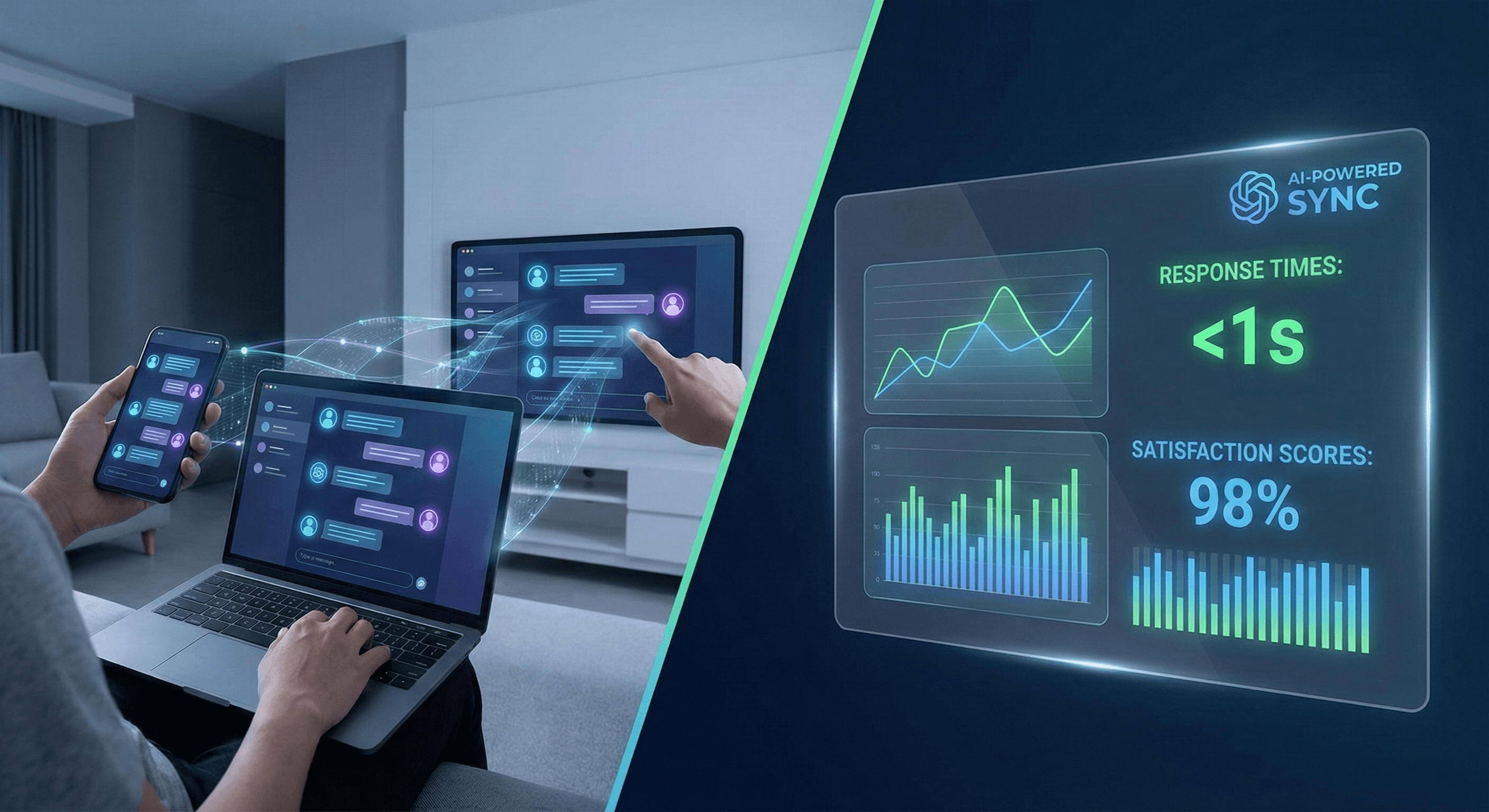
Introduction: Customer Support Has Changed Forever
The customer support landscape in 2026 looks nothing like it did three years ago.
A customer texts your business at 2 AM with an image of a broken product. Your AI chatbot instantly analyzes the photo, identifies the issue, checks warranty status, and processes a replacement order—all before the customer finishes typing their second message.
Another customer switches from typing to voice mid-conversation because they're driving. The AI seamlessly continues the discussion without missing context or forcing them to start over.
This isn't science fiction. This is customer support in 2026.
By 2026, customer service leaders will increasingly rely on AI for speed, scale, and always-on support, and the numbers back this up: AI is projected to handle 95% of all customer interactions by 2025, encompassing both voice and text.
But here's what most articles won't tell you: the transformation isn't about replacing humans with robots. It's about fundamentally reimagining how businesses interact with customers at scale while maintaining—and often improving—the quality of those interactions.
In this guide, you'll discover the real trends driving AI chatbot adoption in 2026, understand what's actually working (versus what's just hype), and learn how businesses of all sizes are leveraging these technologies to deliver exceptional support without exponentially increasing costs.
The State of AI Chatbots in 2026: By The Numbers
Let's start with the data that defines this moment in customer support history.
Market growth and adoption:
The global chatbot market was valued at $7.76 billion in 2024, with analysts expecting the conversational AI market to reach $61.69 billion by 2032. This explosive growth reflects not speculation but actual business adoption driven by measurable ROI.
80% of companies are either using or planning to adopt AI-powered chatbots for customer service by 2025, according to Gartner. This means AI chatbots have crossed the chasm from early adopter technology to mainstream business infrastructure.
Customer acceptance:
Perhaps more telling than business adoption is customer sentiment. Over 67% of consumers worldwide have engaged with a chatbot for customer support in the past year, demonstrating widespread acceptance rather than resistance.
Even more striking: 62% of customers prefer engaging with chatbots over waiting for human agents for routine questions. The shift in customer expectations is complete—instant, accurate answers now matter more than whether those answers come from humans or AI.
Economic impact:
The financial case for AI chatbots has become undeniable. Businesses implementing AI chatbots have reported significant cost reductions, with companies like NIB saving $22 million by automating customer service processes.
The cost difference is stark: chatbot interactions average $0.50 per interaction compared to $6.00 for human customer service interactions—a 12x difference. Gartner predicts that by 2026, AI-powered customer service will reduce contact center labor costs by $80 billion globally.
Performance metrics:
Beyond cost savings, AI chatbots are delivering measurable service improvements. Bank of America's "Erica" has handled 2 billion interactions and resolved 98% of customer queries within 44 seconds, with clients engaging 56 million times monthly.
AI chatbots can manage up to 80% of routine tasks and customer inquiries, freeing human agents to focus on complex, high-value interactions that require judgment, empathy, and creative problem-solving.
These aren't projections—they're current realities shaping how businesses approach customer support in 2026.
Trend 1: From Omnichannel to Multimodal Support
The biggest shift in customer support this year isn't about adding more channels—it's about how AI handles multiple types of input within the same conversation.
What multimodal actually means:
About 76% of customers say they'd choose a company that lets them drop text, images, and video into the same conversation without restarting. This is multimodal support—the ability to seamlessly blend different communication types in one fluid interaction.
Think about how this changes support: a customer can start by typing "my product isn't working," then upload a photo showing the issue, then switch to voice because they need to multitask, then receive a video tutorial showing the solution—all without the conversation breaking or requiring them to repeat information.
This customer service statistic shows the connection clearly: customers communicate like this with friends already, and now they want businesses to meet them at that same level.
Why this matters now:
Traditional omnichannel support—being available across email, chat, phone, and social media—became table stakes years ago. But those channels typically operated in silos. An email thread stayed email. A chat stayed chat. Moving between them meant starting over.
Modern AI chatbots process visual information, understand voice naturally, analyze videos, and respond appropriately regardless of input type. If a customer sends a photo of an error message, the AI doesn't ask them to describe it in text—it reads the image directly and provides relevant troubleshooting.
Real implementation example:
Consider an e-commerce support scenario: A customer texts asking about a delayed package. The AI provides tracking information instantly. The customer then uploads a photo of damage they received. The AI analyzes the image, confirms visible damage, cross-references the order, and initiates a replacement—all within the same 90-second conversation thread.
This wasn't technically possible three years ago at scale. In 2026, it's becoming the expected standard.
Trend 2: Memory-Rich AI That Actually Remembers
One of the most frustrating aspects of traditional customer support—repeating yourself every time you contact a company—is being eliminated by memory-rich AI systems.
Context that persists across sessions:
Memory-rich AI remembers. It holds onto information, context, and preferences across every session, making support faster and far more personal. This isn't just about pulling up account information—it's about understanding the full history of a customer's interactions, issues, and preferences.
When you contact support as a returning customer, the AI already knows your previous issues, how they were resolved, what products you own, what questions you've asked before, and even your communication preferences. You don't start from scratch.
The personalization impact:
Over 67% of customers now expect brands to offer more personalization, especially since AI can actually analyze their interactions and deliver on it. Memory-rich AI makes this level of personalization scalable—something impossible with human-only support at any reasonable cost.
A practical example: A customer reaches out about setting up an integration. The AI remembers they're on the Pro plan, previously asked about a similar integration six months ago, had trouble with API authentication, and prefer detailed written instructions over video tutorials. The response reflects all this context automatically.
How it works in practice:
A customer reaches out late at night, panicking about a failed payment that might cut off their service right before a product launch. The AI agent pulls up their account history and immediately grants a temporary access extension, while flagging the billing issue for review.
The next morning, when a human billing specialist follows up, they don't start from scratch. They see the full story: the failed payment, the customer's concern about their launch, the temporary fix the AI provided, and all relevant account context. The result is seamless, efficient resolution that feels deeply personalized.
Trend 3: Global Support With 100+ Language Capabilities
Language barriers are collapsing as AI chatbots achieve true multilingual capability—not just translation, but native-level understanding across hundreds of languages.
Beyond simple translation:
The difference between translation and true multilingual support is profound. Translation takes text from one language and converts it to another, often awkwardly. True multilingual AI understands intent, cultural context, and linguistic nuance in each language natively.
Modern AI chatbots in 2026 support 100+ languages with natural, conversational fluency. A customer can ask a question in Spanish, switch to English mid-conversation, and receive contextually appropriate responses in both languages without the AI losing track or providing robotic-sounding replies.
The business impact:
For businesses, this removes the need to hire support teams fluent in dozens of languages. A single AI chatbot trained on your business knowledge can serve customers globally, instantly, in their preferred language.
Consider the economics: hiring multilingual support agents for 24/7 coverage across even 10 languages would require significant staffing. An AI chatbot handles 100+ languages with the same deployment, serving customers in Tokyo, São Paulo, Paris, and Cairo with equal fluency.
Real-world capability:
Platforms like customsupportai.com now offer support for 100+ languages without any configuration complexity. The AI automatically detects the customer's language and responds appropriately, making global expansion dramatically simpler for businesses of any size.
This isn't limited to major languages. Customers speaking regional dialects, minority languages, or code-switching between languages (like Spanglish or Hinglish) get natural, helpful responses. The technology has matured from "technically multilingual" to genuinely global.
Trend 4: AI-Backed Customer Satisfaction Measurement
How we measure support quality is changing as AI provides more accurate, comprehensive insights than traditional survey methods.
The problem with traditional CSAT:
Manual CSAT surveys, sent post conversations, are losing relevance. Only about 3% of users respond, and feedback usually comes from extreme experiences. This creates massive blind spots—you only hear from very happy or very unhappy customers, missing the vast middle that represents most interactions.
How AI-backed CSAT works:
Instead of relying on surveys, AI analyzes every customer conversation and calculates CSAT automatically. The score is based on real signals like resolution success, conversation tone, whether escalation was needed, response time, and customer language patterns indicating satisfaction or frustration.
This generates accurate CSAT scores for 100% of interactions instead of the 3% who complete surveys. More importantly, it identifies specific problems: which product features generate confused questions, which documentation gaps cause repeated issues, or which agent responses correlate with high satisfaction.
Actionable insights at scale:
What makes AI-backed CSAT even more powerful is how actionable it is. Scores are sortable by agent, AI agent, ticket category, and time period. CX leaders can spot trends instantly.
You can see that billing questions on Fridays have lower satisfaction scores (maybe because customers are rushing before the weekend), or that questions about Feature X consistently generate frustration (indicating a documentation or UX problem), or that certain agents excel at de-escalating frustrated customers.
This level of insight was impossible with manual surveys. In 2026, it's becoming standard for businesses serious about support quality.
Trend 5: Human-AI Collaboration (Not Replacement)
Despite headlines about AI replacing jobs, the reality in 2026 is sophisticated collaboration between human agents and AI systems.
The "Connected Rep" approach:
By 2026, customer service teams that implement a Connected Rep technology (also known as Expert Assist technology) will improve contact center efficiency by up to 30%, according to Gartner.
Connected Rep technology doesn't replace human agents—it makes them dramatically more effective by providing real-time context, suggested responses, and automated routine tasks. Think of it as giving every agent an AI assistant that handles research, data entry, and knowledge retrieval while they focus on the conversation.
How agents use AI in practice:
When a complex issue gets escalated from the AI chatbot to a human agent, that agent receives the full conversation history, customer account details, relevant knowledge base articles, and even suggested solutions based on how similar issues were resolved previously.
The agent doesn't waste time asking questions the customer already answered. They don't hunt through documentation. They immediately engage with solving the actual problem, armed with all relevant context and information.
The training shift:
PartnerHero's survey reveals that organizations have already started investing in training their customer service teams to maximize the effectiveness of AI tools in 2026. A majority of organizations (63%) have implemented formal training programs to help their teams effectively use AI tools.
Support agents are evolving from answering routine questions to managing AI systems, handling complex edge cases, building customer relationships, and improving the knowledge base that AI draws from. It's a more skilled, more valuable role—not a diminished one.
Trend 6: Explainability and Trust in AI Decisions
As AI handles more customer interactions, transparency about how it makes decisions has become critical for maintaining trust.
Why explainability matters:
Customers are comfortable with AI assistance, but they want to understand why the AI made specific recommendations or decisions. When an AI chatbot suggests a particular troubleshooting step or quotes a policy, customers increasingly ask "why that solution?" or "how did you determine that?"
Modern AI systems in 2026 provide clear reasoning: "Based on your account type and usage pattern, I'm suggesting this solution because it resolved similar issues for 89% of customers with your configuration."
Building trust through transparency:
Compliance and transparency should be one of your top customer service priorities in 2026. It's particularly critical considering over half of customers suspect their personal information is being mishandled.
Customers want to know what data the AI accesses, how it's used, and how long it's retained. AI systems that clearly communicate their data practices and decision-making logic build trust; those that operate as "black boxes" generate suspicion and resistance.
Implementation through RAG:
Technologies like Retrieval-Augmented Generation (RAG) help maintain explainability. Instead of the AI generating answers from opaque training data, RAG systems retrieve specific information from your knowledge base and cite sources.
When the AI answers a question, it can point to exactly which help article, policy document, or previous ticket informed its response. This transparency reassures customers and helps businesses maintain accuracy by making it clear when answers come from approved sources versus AI inference.
Trend 7: Real-Time Insights Replace Periodic Reports
The shift from monthly support reports to real-time analytics dashboards is transforming how businesses manage customer experience.
The limitation of periodic reporting:
Traditional support operated on delayed feedback loops: monthly reports showing last month's metrics, quarterly reviews of CSAT trends, annual analysis of support costs. By the time you identified problems, you'd already provided poor service to hundreds or thousands of customers.
Real-time visibility:
About 94% of service leaders say that real-time insights are vital to meeting customer expectations. Companies are not only using AI to respond to customer queries, but also to collect feedback in real time.
Modern AI systems surface issues as they emerge: a sudden spike in questions about a specific feature suggests a bug or unclear documentation. A particular knowledge base article gets referenced frequently but doesn't resolve issues, indicating content that needs improvement. Response times creep up during specific hours, revealing staffing gaps.
Proactive problem-solving:
Through chatbot surveys and live response tracking, companies can instantly adapt their support approach. If customers start asking confused questions about a new feature, you can update documentation immediately rather than discovering the problem weeks later through surveys.
This real-time feedback also helps product teams. When support data shows customers struggling with a specific workflow, product managers can prioritize UX improvements based on actual usage friction rather than guessing what needs attention.
What This Means for Businesses in 2026
Understanding these trends is one thing. Implementing them effectively is another.
Start where you are:
You don't need to implement every trend simultaneously. Most successful businesses start by automating their highest-volume, most repetitive support questions—password resets, order status, hours and location, pricing inquiries, and basic troubleshooting.
These "quick wins" immediately reduce agent workload while building confidence in AI accuracy. Once that foundation works well, expand to more complex use cases.
Focus on knowledge quality:
AI chatbot effectiveness directly correlates with training data quality. The businesses seeing the best results invest in comprehensive, well-organized documentation. Your knowledge base becomes your AI's expertise—make it thorough, accurate, and regularly updated.
Maintain human oversight:
This points to a clear emerging trend in customer service: AI in customer support is not a phase, it is here to stay forever. The real question is no longer whether AI will be used, but how quickly it will mature to handle conversations that demand empathy, judgment, and nuance.
Plan for hybrid support from day one. AI handles volume and routine questions; humans handle complexity, relationship-building, and situations requiring judgment. This division of labor delivers better outcomes than either approach alone.
Measure what matters:
Track metrics that reflect business value, not just AI activity: customer satisfaction scores, resolution time, support cost per ticket, first-contact resolution rate, and ultimately customer retention and lifetime value.
If AI adoption improves these metrics, it's working. If not, dig into why—it might be training data gaps, unclear escalation criteria, or poor integration with existing systems.
Common Misconceptions About AI Chatbots in 2026
Let's address what's *not* true about AI chatbots, despite persistent myths.
Misconception 1: "AI chatbots will eliminate support jobs"
Reality: 77% of customer service reps say their workload and the complexity of customer issues have increased compared to a year ago. AI helps agents handle this increased complexity—it doesn't eliminate the need for human expertise.
What's changing is the nature of support work. Agents spend less time on repetitive questions and more time on complex problem-solving, customer relationship management, and improving support processes.
Misconception 2: "Customers hate talking to bots"
Reality: 48% of customers say it's harder to tell the difference between AI and human service reps. When AI provides fast, accurate, helpful responses, customers don't care whether it's human or machine—they care about getting their problem solved.
The frustration with "bots" comes from *bad* bots—rigid, rule-based systems that can't understand natural language and force customers through frustrating decision trees. Modern conversational AI is dramatically different.
Misconception 3: "Only enterprise companies can afford AI chatbots"
Reality: AI chatbot platforms have become accessible to businesses of all sizes. Solutions exist at every price point, from free plans for small businesses testing the technology to enterprise platforms handling millions of conversations.
The ROI calculation often favors smaller businesses even more strongly—a company spending 20 hours weekly answering repetitive questions sees immediate, measurable value from automation.
Misconception 4: "AI chatbots need constant maintenance"
Reality: While AI chatbots benefit from periodic review and improvement, modern systems don't require daily hands-on management. Many businesses review chatbot conversations weekly, update documentation monthly, and otherwise let the system run autonomously.
This is especially true for platforms using RAG architecture—when you update your knowledge base or help center, the AI automatically incorporates that new information without manual retraining.
The Technology Behind 2026 AI Chatbots
Understanding the technical foundation helps evaluate different platforms and set realistic expectations.
Large Language Models (LLMs):
Modern AI chatbots are powered by LLMs like GPT-4, Claude, and similar models that understand natural language at near-human levels. These models can interpret complex questions, understand context, and generate conversational responses.
The key advancement in 2026 is these models' ability to follow instructions consistently, stay on topic, and integrate with external knowledge sources rather than just generating plausible-sounding text.
Retrieval-Augmented Generation (RAG):
RAG addresses one of the biggest concerns with AI chatbots: accuracy. Instead of the AI generating answers from training data (which might be outdated or wrong), RAG systems retrieve relevant information from your current documentation and use that as the basis for responses.
This architecture ensures the AI provides current, accurate information specific to your business while being able to cite sources. If your return policy changes, you update the policy document and the AI immediately reflects the new information.
Intent Recognition and Routing:
Advanced AI chatbots don't just answer questions—they understand what customers are trying to accomplish and route them appropriately. If someone asks "I need to cancel my subscription" and sounds frustrated, the AI recognizes high churn risk and escalates immediately to a retention specialist rather than walking through self-service cancellation steps.
This intelligent routing ensures the right issues get human attention while automating what can safely be automated.
Continuous Learning Systems:
The best AI chatbots improve automatically through use. When humans correct AI responses, handle escalated issues, or update documentation, those improvements feed back into the system's knowledge.
This creates a positive feedback loop: the AI gets more accurate over time, handles more questions successfully, requires fewer escalations, and frees humans to focus on adding new knowledge rather than answering repeat questions.
Getting Started With AI Chatbots in 2026
If you're ready to implement AI chatbot support, here's a practical roadmap.
Step 1: Audit your current support (Week 1)
Export 3-6 months of support tickets and categorize them. What percentage are repetitive questions with documented answers? Which questions appear most frequently? What's your current cost per ticket and response time?
This analysis reveals your opportunity. If 60-70% of questions are routine (typical for most businesses), AI deflection can dramatically reduce workload and costs.
Step 2: Prepare your knowledge base (Week 2-3)
Compile and organize your documentation. Ensure help articles are current, clear, and comprehensive. Fill obvious gaps—if customers frequently ask questions not covered in documentation, write those articles now.
Quality knowledge base content directly determines AI chatbot effectiveness. This upfront investment pays dividends.
Step 3: Choose a platform (Week 3)
Select an AI chatbot platform matching your business size, technical capability, and budget. Key evaluation criteria:
- How easily can you train it on your specific business?
- Does it provide natural conversations or rigid decision trees?
- How does escalation to humans work?
- What's the actual pricing structure?
- Do they offer support during implementation?
For businesses seeking modern AI capabilities with straightforward implementation, platforms like customsupportai.com offer RAG-based architecture, 100+ language support, and simple setup—making advanced AI chatbot technology accessible without enterprise complexity or pricing.
Step 4: Implement and test (Week 4-6)
Train your chatbot on your knowledge base. Configure escalation rules, tone, and behavior. Test extensively with your team before exposing it to customers.
Start with a soft launch to 25% of traffic. Monitor closely, gather feedback, and refine based on real interactions.
Step 5: Scale and optimize (Ongoing)
Once your soft launch proves successful, expand to all customers. Establish regular review processes—weekly initially, then monthly as the system stabilizes.
Continuously improve training data based on actual conversations. Track business metrics: Are support costs decreasing? Is customer satisfaction improving? Are agents handling more complex, valuable work?
The businesses seeing the best results treat AI chatbot implementation as an ongoing optimization process, not a one-time project.
The Future Beyond 2026
Looking ahead, several trends will continue evolving.
Increasingly proactive support:
AI will shift from reactive (answering questions) to proactive (identifying potential issues before customers encounter them). Imagine an AI noticing a customer struggling with setup and offering help before they submit a support request.
Deeper emotional intelligence:
Current AI can detect frustration and sentiment. Future systems will recognize subtle emotional cues and adapt responses accordingly—providing more empathy when customers are stressed, more detail when they're confused, or more efficiency when they're in a hurry.
Seamless voice integration:
While text-based chatbots dominate today, voice interactions will become equally sophisticated. Customers will naturally speak to AI assistants rather than typing, with the same quality of understanding and response.
Predictive problem resolution:
AI systems will analyze patterns across thousands of customers to predict common issues. If a feature tends to confuse new users, the AI could proactively offer guidance the moment someone accesses it for the first time.
These aren't distant dreams—they're natural progressions of capabilities already emerging in 2026.
Key Takeaways: AI Chatbots in 2026
Let's consolidate what matters most:
- AI has become mainstream: With 80% of companies using or planning to use AI chatbots, this is no longer emerging technology. It's established business infrastructure for modern customer support.
- Customers prefer it (when done well): 62% of customers prefer chatbots over waiting for humans for routine questions. The key phrase is "when done well"—quality implementation matters enormously.
- The technology has matured: Multimodal input, memory-rich context, 100+ language support, and explainable AI represent genuine capability improvements, not just hype.
- Human-AI collaboration wins: The most successful implementations don't replace humans—they let AI handle volume and routine work while humans focus on complexity, relationship-building, and continuous improvement.
- ROI is clear and measurable: From 12x cost reductions per interaction to 30% efficiency improvements with Connected Rep technology, the financial case for AI chatbots is well-established.
- Implementation is accessible: You don't need enterprise budgets or technical teams to benefit from AI chatbots. Solutions exist for businesses of every size, with clear paths from free plans to scalable paid tiers.
- Quality matters more than speed: Rushing to deploy AI without proper knowledge base preparation, testing, and human oversight creates poor experiences. Taking time to implement thoughtfully generates dramatically better results.
Transform Your Customer Support in 2026
The transformation of customer support through AI isn't coming—it's already here. The question isn't whether to adopt AI chatbots, but when and how.
Every day without AI support means customers waiting hours for answers that could be instant, support costs that could be halved, and agents spending time on repetitive questions instead of building relationships and solving complex problems.
Platforms like customsupportai.com make implementation straightforward:
Train your AI chatbot on your business knowledge in minutes using your website and documentation. Deploy it with 100+ language support built-in. Maintain full human oversight with seamless escalation when needed.
Start with a free plan to test the technology with your actual customers and support volume. Expand to paid tiers as you prove value and scale capacity.
The businesses thriving in 2026 aren't those with the biggest support teams—they're those delivering the fastest, most accurate, most helpful support at sustainable costs.
Visit customsupportai.com to explore how modern AI chatbots can transform your customer support with the trends and capabilities discussed in this guide.
The future of customer support is here. The only question is whether you'll lead this transformation or follow it.